
Finding Your Footing After the Pivot
2Q 2026
By John Riddle, CFA
If the first quarter of the year was about adjusting to a changed map, the second quarter was about finding our footing and recognizing that the fundamentals of this expansion remain remarkably intact.
Following a winter correction that saw the S&P 500 drop 4.3%, the market completely reversed course. Equities staged a powerful, resilient rally, and the S&P 500 crossed the 7,500 threshold for the first time, clawing back all of its early losses to finish the first half of 2026 up a strong 10.2%[1].
What changed? In short, the macro headwinds that felt so heavy in April began to resolve. The markets didn’t break; instead, the underlying strength of corporate earnings reasserted itself as the dominant force driving asset prices.
Macro Realities: The Oil Round-Trip and a New Era at the Fed
The most urgent pressure point from last quarter was the energy shock. Brent crude, which had spiked to near $140 a barrel in April as conflict threatened the Strait of Hormuz, completed a full round-trip.[2] As a ceasefire took hold, supply anxieties eased, and oil prices slid back down toward the $70 mark by late June.[2]
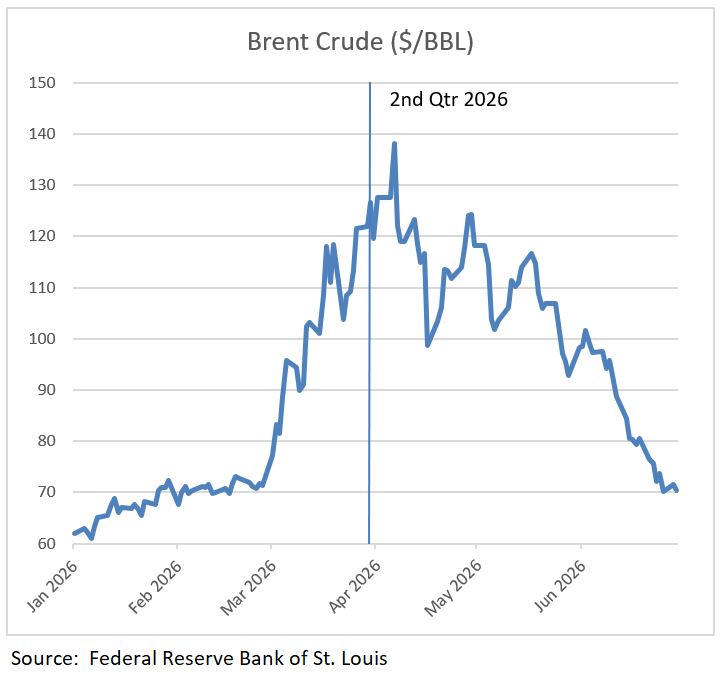
This commodity pullback is a welcome relief for an economy nursing an inflation hangover. The spring oil spike had pushed May consumer prices up to a three-year high of 4.2%. Confirming that inflation is mostly an oil story, consumer prices were only up 2.9% after stripping out energy prices[2]. With energy costs now rapidly deflating, the underlying data suggests that inflation is poised to follow oil back down, removing a significant piece of macro uncertainty.
Meanwhile, the historic transition at the Federal Reserve officially began. At the June FOMC meeting, newly installed Fed Chair Kevin Warsh made his public debut [3]. The committee voted unanimously to hold the federal funds rate steady at 3.50% to 3.75%, but the real story was the shift in leadership style[3]. Chair Warsh sharply cut the length of the Fed’s policy statement and noticeably dialed back the expansive “forward guidance” favored by his predecessor [3],[4]
Furthermore, the updated “dot plot” revealed a deeply split committee: roughly half the officials anticipate rate hikes later this year to guarantee price stability, while the other half favors holding steady[3]. The reality for portfolios is clear: the Fed is hyper-focused on its inflation-fighting credibility, and any near-term rate relief is off the table until the inflation data matches their targets.
The Return of Earnings Power and Market Breadth
Lost in the constant chatter surrounding the Fed transition is that corporate performance has been nothing short of spectacular. For the second quarter of 2026, the S&P 500 is tracking toward an extraordinary year-over-year earnings growth rate of 23.3% [5]. If that holds, it will mark our second consecutive quarter of corporate earnings growth eclipsing 20%[5].
Importantly, we are seeing a healthy rotation in how that performance is being rewarded. Last quarter, we noted that the “easy part” of riding mega-cap tech momentum was over, as investors began demanding evidence of actual financial returns on massive artificial intelligence capital expenditures. In the second quarter, that rotation materialized.
While the broader AI trade continues to mature, market leadership widened substantially. Diversification, which felt like a headwind for the last three years, is finally working. Small caps, mid caps, and international equities all outpaced the S&P 500 over the quarter[2]. The market is no longer just buying a handful of massive tech darlings; it is rewarding solid, cash-generating businesses across the economic spectrum.
The first half of 2026 put investors through a gauntlet: a commodity shock, an inflation scare, a regional war, and a leadership transition at the world’s most powerful central bank. Through it all, the economy expanded, and companies grew their bottom lines.
Navigating a changed map requires tuning out the daily media noise and staying anchored to cold, objective economic data. We are profoundly grateful for your continued partnership. If the recent shifts in the market have you thinking about your broader allocation or your long-term plan, please know that we are always here to talk.
This commentary is for informational purposes only and does not constitute investment advice. Past performance is not indicative of future results. The views expressed are those of Brand Asset Management Group as of the date of publication and are subject to change.
[1] Source: Chevy Chase Trust / MSCI Data: Second Quarter 2026 Market Review, published July 6, 2026.
[2] Source: Defiant Capital Group: 2026 Q2 Market Recap (Mid-year Review) & Q3 Outlook, report published July 6, 2026.
[3] Source: J.P. Morgan Wealth Management: What Happened at Kevin Warsh’s First Fed Meeting as Chair? 3 Key Takeaways from the June 2026 FOMC Decision, published June 18, 2026.
[4] Source: Financial Times: What will FOMC minutes reveal about Warsh’s debut at the Fed?, published July 5, 2026.
[5] Source: FactSet Research Systems: FactSet Earnings Insight, report published July 2, 2026.