
Not All Risk Is Created Equal
By John Riddle, CFA
Most investors think of risk as one thing: the chance their portfolio loses value. Inside a portfolio, though, there are several kinds of risk, and they behave differently.
At our most recent Investment Committee meeting, we walked through how we think about those differences. Some risks are worth carrying because investors are paid for them over time. Some almost disappear inside a well-diversified portfolio. Some carry a cost with little reliable reward.
When you put together a large group of securities, certain kinds of risk tend to cancel each other out pretty quickly. Other kinds are more persistent. Those persistent risks shape long-term results, so they get most of our attention.
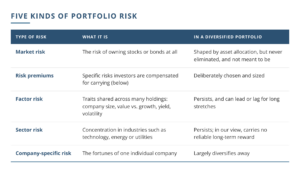
FIVE KINDS OF RISK
We group portfolio risk into five broad categories. Only some of them shape what families experience over time.
Market risk. This is the risk of being invested at all, and it is the main source of long-term return. We would argue you don’t want to eliminate it. When we set an asset allocation with a family, we are deciding how much of this risk to take.
Factor and sector risk. These risks are often spread across many funds, so they are easy to overlook. One we’re monitoring now: a small number of very large companies make up an unusually large share of broad market indexes. No single statement shows it clearly, but it adds up across a portfolio.
Company-specific risk. This is what most fund marketing focuses on: the idea that a manager can pick the stocks that will outperform. It’s what everybody talks about, but it affects almost nothing in a diversified portfolio. In large, diversified portfolios, it is difficult or impossible to even measure.
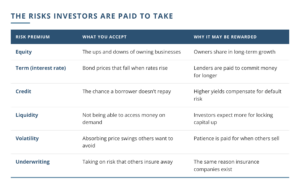
THE RISKS INVESTORS ARE PAID TO TAKE
Our starting point is that there are no free lunches. Every investment earns its return through income or growth, and we don’t believe markets pay investors for risk that can be diversified away. Historically, they have paid for the risks below.
A quick illustration of interest-rate risk: a bond portfolio with a duration of about 5 years would be expected to lose roughly 5% in price if rates rose 1 percentage point, and gain roughly 5% if rates fell by the same amount.
None of these premiums pays every year, and each can go unrewarded for long periods. The goal is to hold them deliberately, in amounts that fit each family’s goals and time horizon.
PRINCIPLES WE USE TO REVIEW PORTFOLIOS
A few convictions follow from that view of risk. They shape the questions we ask every quarter.
- Expenses are the one sure thing that happens to every investment we own. Generally, the more layers of fees, the worse the returns, so each fee has to justify itself.
- Process over recent results. Performance is going to be volatile; it will go up and down. We spend much more time on whether a manager’s process is sound than on the last few quarters.
- We’re not sure complexity is a risk you get rewarded for. It is certainly something you get rewarded for if you’re on the selling side of it.
- Risk is more predictable than returns. Past performance has very little correlation with future performance. How much an investment tends to move is more stable over time, so it is more useful for planning.
- Portfolio structure. In a diversified portfolio, the overall mix of market exposure, factors and risk premiums matters far more than any single holding.
WHAT THIS MEANS FOR YOU
Markets will have down quarters. A decline does not by itself mean the plan is off track. It is often part of carrying risks that have historically been rewarded over longer periods.
Our job as a committee is to make sure each risk in your portfolio is there for a reason, sized to your goals, and reviewed regularly. That is the work we do each quarter.
If you’d like to talk through how these ideas apply to your portfolio, we welcome the conversation.
This commentary is for informational purposes only and does not constitute investment advice. Past performance is not indicative of future results. The views expressed are those of Brand Asset Management Group as of the date of publication and are subject to change.