
Book Review: The Uncertainty Solution by John M. Jennings
Summary by Tanner Brand and Josiah Gould
The Uncertainty Solution, by John M. Jennings offers a refreshing and deeply insightful perspective on investing, one that acknowledges the uncomfortable truth: the future is unknowable, and markets are inherently unpredictable. Rather than resisting this reality, Jennings encourages investors to embrace uncertainty as a fundamental feature of the financial landscape. His book is not a technical manual or a list of stock-picking tips. Instead, it’s a guide to developing the right mindset and behavioral habits to navigate markets with confidence and clarity.
At the heart of Jennings’ philosophy is the idea that our brains are wired to seek patterns and certainty, even when none exist. This tendency can lead to overconfidence, poor decision-making, and a false sense of control. Investors often fall into the trap of believing that with enough information or the right analysis, they can predict market movements. Jennings dismantles this illusion with compelling evidence from psychology, behavioral finance, and real-world investing.
One of the book’s central themes is the distinction between the economy and the stock market. See figure 3.4 that shows GDP in relation to the market.
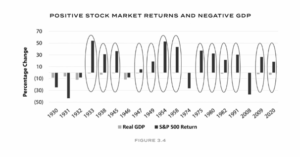
Many investors assume that strong economic news should lead to rising markets, and vice versa. But Jennings explains that the stock market is a complex adaptive system that is forward-looking, emotionally driven, and influenced by countless variables. It often behaves in ways that defy logic or economic fundamentals. Understanding this disconnect helps investors avoid reacting impulsively to headlines or economic data.
Jennings builds on something that many investors become fixated on, the idea that a highly complex portfolio will perform the best. He explains that “Greater size and complexity generate fees and taxes that eat into returns and make practicing good investment behavior more challenging.” You may experience higher stated returns, yes, but generating a 10% return with fees that eat 2% of that, is it better to just buy a fund that makes 8% with less volatility? These are some of the questions that he poses for the reader to think about. Complexity is not all bad. There are some cases where adding more complex funds will improve the portfolio’s overall yield, but this should be done deliberately and carefully. The problem arises when you don’t see how much a fund actually costs.
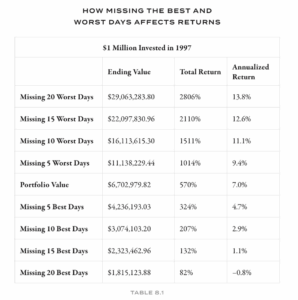
Jennings also addresses the seductive but dangerous idea of market timing. While it’s tempting to believe that we can sidestep downturns and jump in at the right moments, the reality is that even professional investors rarely get this right. Successful timing requires two correct decisions: when to get out and when to get back in. Missing just a few of the market’s best days can significantly reduce long-term returns. See table 8.1
Instead of trying to outguess the market, Jennings advocates for staying invested through cycles, maintaining a diversified portfolio, and focusing on long-term goals. In a particularly powerful example, Jennings recommends that investors resist the urge to “tinker” with their portfolios. “If you are a man, tell yourself to invest like a woman. If you are a woman, try to invest like a dead person.” Jennings shows, with examples, that restraint often outperforms activity. Jennings argues that during periods of market volatility or uncertainty, the instinct to act can lead to costly mistakes. Instead, he encourages investors to pause and rebalance toward a predetermined allocation. This model reinforces the value of patience and emotional control, reminding readers that long-term success often comes not from reacting, but from remaining committed to a well-thought-out plan.
“Investment experts” are often attempting to “see around the corner” with market predictions. Jennings offers his critical insight saying, “The biggest investing misconception is that forecasting is a key component of successful investing. It’s not.” While slightly disconcerting to some, it can be freeing to decide to stop sifting through endless sources of information, and instead rely on the idea that the appropriate investment allocation and time in the market will be what ultimately makes the difference.
Throughout the book, Jennings introduces a series of mental models that are simple yet powerful frameworks for thinking more clearly about investing. These include concepts like “regression to the mean”, a statistical tendency for extreme outcomes to normalize over time, and “the inevitability of improbability”, which helps us accept that rare events happen more often than we expect. These models serve as guardrails, helping investors avoid common cognitive traps and stay grounded in rational thinking.
Another powerful mental model Jennings explores is the principle that correlation does not imply causation. In the world of investing, it’s easy to be misled by patterns that appear meaningful but are actually coincidental. For example, just because two variables such as interest rates and stock prices move together, doesn’t mean one causes the other. Jennings warns that our brains are wired to seek connections and explanations, often leading us to draw false conclusions from random or unrelated data. This model serves as a critical reminder to approach market analysis with skepticism and discipline, resisting the urge to act on superficial relationships. By internalizing this concept, he believes investors can avoid one of the most common cognitive traps and make more rational, evidence-based decisions.
Perhaps the most empowering message in The Uncertainty Solution is that investors don’t need to predict the future to succeed. What matters most is behavior: the discipline to stick to a plan, the humility to accept what we can’t control, and the patience to let time and compounding do their work. Jennings encourages readers to focus on building robust, resilient portfolios that can weather a wide range of outcomes, not just the ones we hope for.
In sum, The Uncertainty Solution is a thoughtful, well-reasoned guide for anyone who wants to invest more wisely by thinking more clearly. It’s especially valuable for those who feel overwhelmed by market volatility or frustrated by the unpredictability of financial news. By shifting the focus from prediction to preparation, Jennings offers a path to greater confidence, peace of mind, and long-term success.
Jennings, John M. The Uncertainty Solution. 1st. Greenleaf Book Press, 2023