
When Rates Push Back
3Q 2026
By John Riddle, CFA
The third quarter was a bond market story. Stocks edged higher, but long-term Treasury yields rose by the most in a quarter since 1994, and the Federal Reserve raised short-term rates for the first time since 2023[1, 2].
Last quarter we wrote that oil had made a full round trip and that inflation looked poised to follow it down. Oil turned back up, and inflation pressure turned up with it. Below, we cover what happened and what it means.
The Return of Earnings Power and Market Breadth
The S&P 500 gained 2.3% in the third quarter and is up 12.7% for the year[3]. Beneath that, the quarter was uneven. Small caps (the Russell 2000) fell 7.2% but are still up 13.7% this year, slightly ahead of the S&P 500[3]. Within small caps, value (down 4.9%) held up much better than growth (down 9.4%)[3]. Large companies fared better: large-cap value rose 2.6% and large-cap growth rose 0.9%, and for the year value leads by a wide margin, up 19.3% against 6.3%[3].
International stocks were roughly flat. Developed markets gained 0.8% and emerging markets lost 0.4%, though emerging markets are still up 23.4% for the year[3].
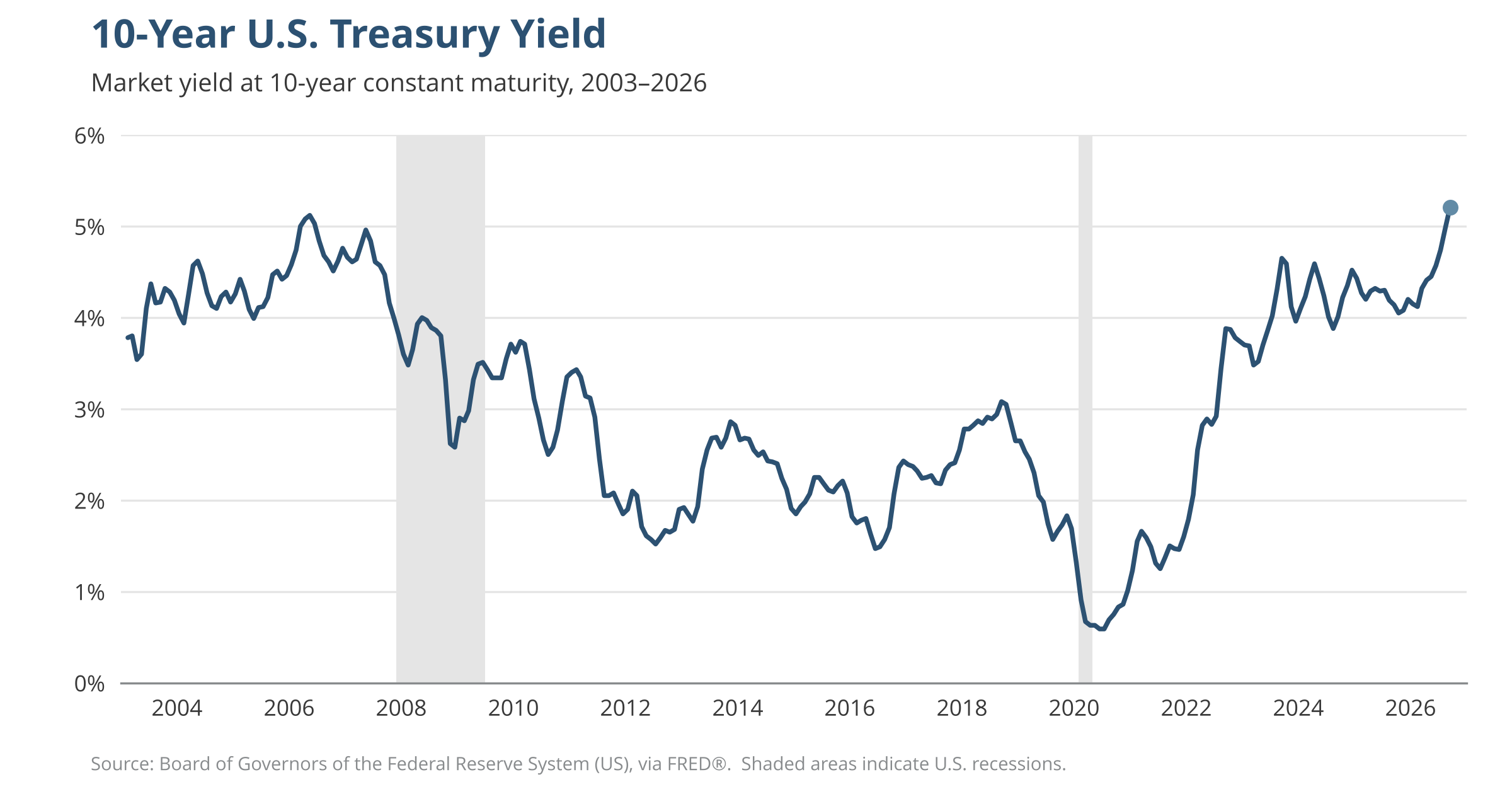
Bonds had a hard quarter. The Bloomberg U.S. Aggregate Bond Index fell 3.5% and is down 2.9% for the year[3]. Investment-grade corporate bonds lost 3.7% and high-yield bonds lost 1.8%[1]. The 10-year Treasury yield reached 5.34% on October 1, its highest level since 2002[2]. When yields rise, bond prices fall, and longer bonds fall the most. Short-term yields moved far less: three-month yields rose about 0.35 percentage points, while 5-year and 10-year yields rose more than 0.80 points[1].
Oil, Inflation and the Fed
Oil rebounded, inflation followed, and the Fed acted.
Brent crude futures rose from about $72 a barrel on July 1 to above $100 by late July and peaked near $109 on September 15, driven by renewed strikes in the Middle East, disruption around the Strait of Hormuz, and attacks on tankers and pipeline infrastructure[4]. Futures settled at $98.03 on September 30[3]. Energy was the best-performing sector in the S&P 500 for the quarter[1].
Inflation followed oil higher. Consumer prices rose 3.7% from a year earlier in September, up from 3.4% in August, with energy prices up 20.4%[5]. Excluding food and energy, the increase was 2.6%, up from 2.4% in August[5]. That gap tells the story: this is mostly an oil problem.
On September 16, the Fed raised its target range by a quarter point to 3.75%–4.00%, in a unanimous 12–0 vote. Chair Warsh said, “Inflation is too high and has been for too long”[6]. The committee’s projections point to at least one more increase this year, with the average year-end projection at 4.1%, up from 3.8% in June, and the Fed now expects 3.7% inflation for 2026 by its preferred measure[6].
If tensions in the Middle East improve, we expect oil, and the inflation pressure that comes with it, to ease. We cannot say when, and this quarter showed how quickly the picture can change.
Earnings Stayed Strong
Corporate earnings remain the strongest part of the picture. FactSet expects S&P 500 earnings to grow 29.5% from a year earlier for the third quarter, which would be the third straight quarter above 25%[7]. Most companies have yet to report, so that figure is an estimate. The index trades at 19.0 times expected earnings over the next 12 months, so investors are already paying for good news[7].
We know a quarter in which bonds fall and smaller companies slide can be uncomfortable to see on a statement. Rising rates hurt in the short run, but they also raise what bonds pay going forward, and earnings are still growing. Thank you for your continued trust. If the quarter has you thinking about your allocation or your long-term plan, please call us.
This commentary is for informational purposes only and does not constitute investment advice. Past performance is not indicative of future results. The views expressed are those of Brand Asset Management Group as of the date of publication and are subject to change.
[1] Source: CACCU, Q3 2026 Market Recap & Q4 Outlook: Fed Raises Rates, published October 5, 2026. First Fed increase since 2023; Q3 changes in Treasury yields.
[2] Source: ROIC.ai, US Treasury yields extend gains, 10-year note tops 5.34%, highest since 2002, October 1, 2026. 10-year yield of 5.34%, 2-year yield of about 4.88%, largest quarterly rise since 1994.
[3] Source: Goldstone Financial Group, Q3 2026 Market Recap: Markets, Rates & Goldstone’s Q4 Outlook, published October 7, 2026. Index returns for Q3 and year to date (S&P 500, Russell, Bloomberg U.S. Aggregate); Brent futures settlement of $98.03 on September 30.
[4] Source: U.S. Energy Information Administration, Crude oil prices and refinery margins generally increased throughout the third quarter, Today in Energy, October 5, 2026. Brent futures path and drivers.
[5] Source: U.S. Bureau of Labor Statistics, Consumer Price Index news release, September 2026, released October 14, 2026. All-items 3.7%, core 2.6%, energy 20.4% (12-month changes).
[6] Source: Charles Schwab (Collin Martin), FOMC decision and Fed projections, published September 16, 2026. Target range of 3.75%–4.00%, 12–0 vote, Chair Warsh quote, projected path for 2026.
[7] Source: FactSet Research Systems, FactSet Earnings Insight, published October 2, 2026. Expected Q3 earnings growth of 29.5%.